Day 0: watching, and blocking the plain attacks
The Add a server page ended with “What is on now”. The Welcome page puts the same day in one line: “The firewall and decoys go live. Every service starts in audit mode: Whitecell records what it would deny, and denies nothing.” Two things run from the first minute.
Your services are watched, not confined. Each service has its limits written: what it may write, which system calls it may make, where it may connect. In audit they stop nothing, and no service was restarted. Its outbound traffic is observed.
The rules block attackers at once. They need no model. An address is blocked when it:
- requests a decoy, a path planted on your websites that no visitor has a reason to ask for;
- guesses SSH passwords;
- scans closed ports and sends a second signal within the hour;
- tries three attacks on a known kind of bug, such as path traversal or command injection, within an hour;
- is one the fleet remembers from an attack elsewhere.
A first block usually lasts an hour; the same address again gets 4 hours, then 24. An address the fleet remembers is blocked for 24 hours at once. Your never-block list and the server’s operator sources are never blocked. An attacker the rules have blocked needs no model. The agent triages what the kernel rules report about your services and investigates what needs a closer look.
Measured on the lab’s control plane on 19 Oct 2026: a block lands in about 5 seconds, median, and its signed receipt a second later.
What it learns
The week exists so that the limits fit the service before they confine it. The system records three things.
- Where each service writes. A file written outside what the limits already allow is recorded by directory, once a day per service. Files in dated subdirectories fold into one place, such as an uploads folder.
- Where each service connects. Each connection out is folded to its network, port and protocol. The system decides each new destination when it first sees it: facts first, one model call for what the facts leave open, a person last.
- What runs on the server. Programs, services that start at boot, listening ports, accounts, cron files and sudoers files. Anything nothing explains is asked about once. A package, the manifest or Whitecell itself is the usual explanation.
The server’s page shows what it has learned. The Writes card lists the places each service writes: “Once a service is confined, these places stay writable and the rest of the disk is read-only.” “Exclude” or “Allow” settles one place yourself.
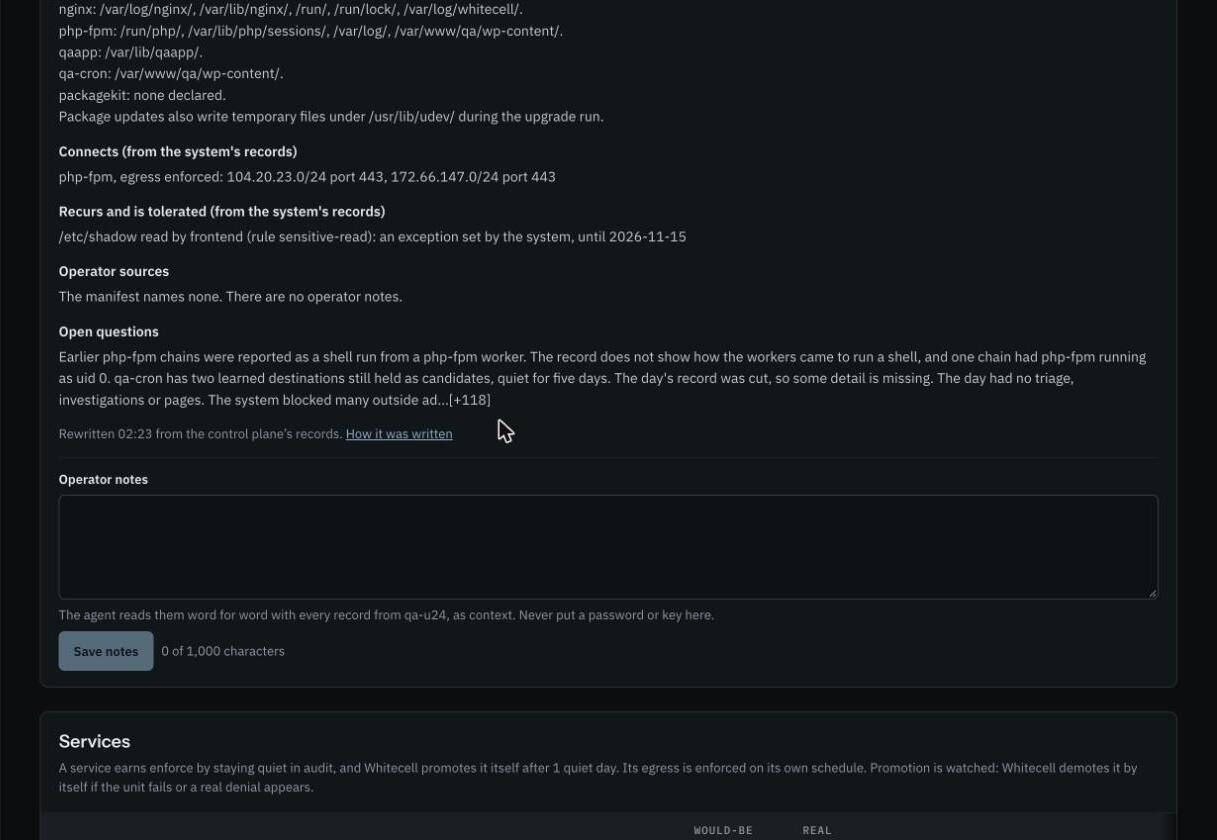
“What the system knows about this server” is rewritten each day under fixed headings: Runs, Writes, Connects, Recurs and is tolerated, Operator sources, and Open questions. The agent reads it with every record from the server. Below it, “Operator notes” is yours: “The agent reads them word for word with every record from web-01, as context. Never put a password or key here.”
Would-be denials and real denials
A would-be denial is something a service’s limits would have stopped, counted while the service is in audit. A real denial is one the limits did stop, once the service is in enforce. A connection to a destination the service’s allowed set does not hold yet counts as a would-be denial too.
Servers shows both per server, and a real denial shows in red. The Services table shows both per service for the last 24 hours, and whitecell status on the server prints them as well. One would-be denial restarts the count of quiet days, so a service that still reaches new places gets its egress enforced before its hardening.
The Services table
The server’s page lists each service in a table. With the default setting its lede reads: “A service earns enforce by staying quiet in audit, and Whitecell promotes it itself after 7 quiet days. Its egress is enforced on its own schedule. Promotion is watched: Whitecell demotes it by itself if the unit fails or a real denial appears.”
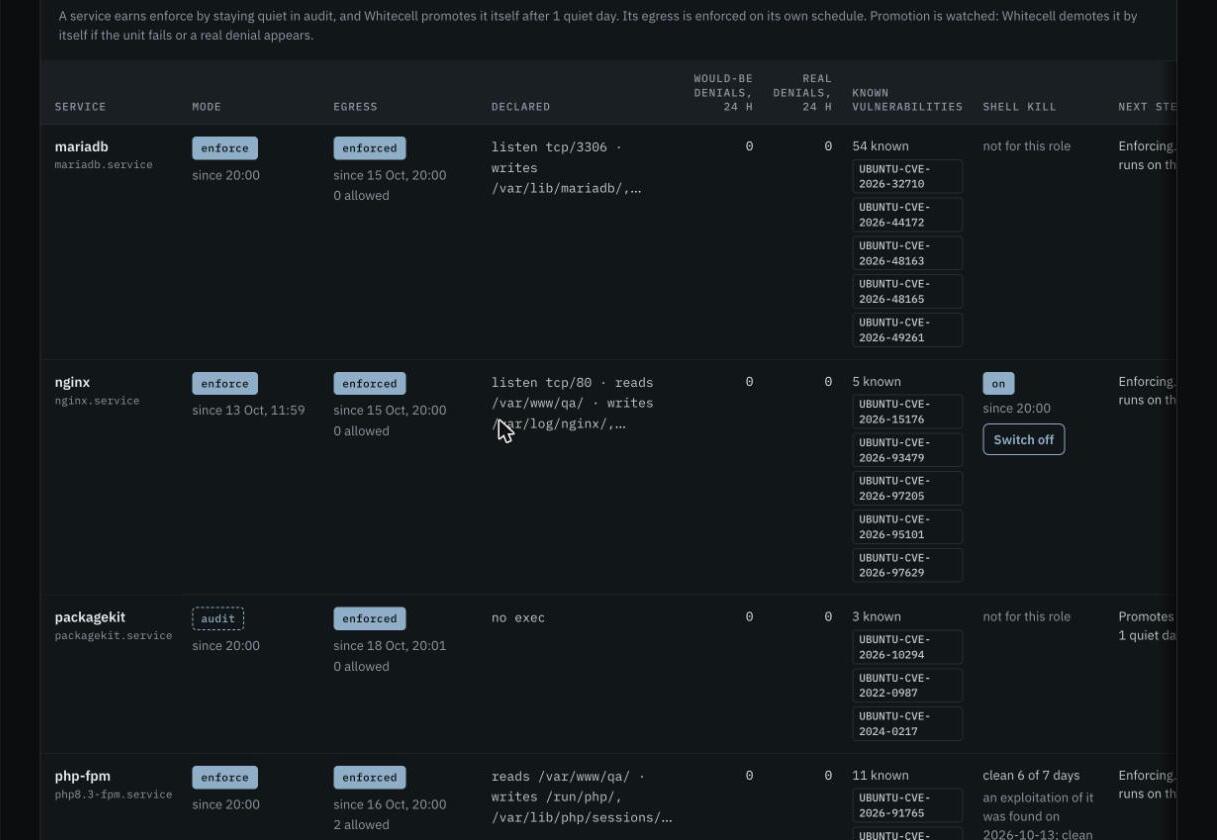
- Service. The name, and the systemd unit under it.
- Mode. audit or enforce, and since when.
- Egress. observing; eligible, “enforced at the next daily evaluation”; enforced, with since when and how many destinations are allowed; or waiting, after a rollback, with when it tries again.
- Declared. What the manifest declares: the ports it listens on and the paths it reads and writes.
- Would-be denials, 24 h and Real denials, 24 h.
- Known vulnerabilities. How many known vulnerabilities the installed version of the service’s package has, with their identifiers. It is advice and never blocks anything.
- Shell kill. For a web, PHP or scheduled-job service, whether a shell the service starts is killed or only watched. It switches on after a clean week, and “Switch off” turns it back.
- Next step. For example “Promotes itself after 7 quiet days (3 of 7).”, “Not quiet yet. It promotes itself after 7 quiet days in a row.”, or “Enforcing. Demote runs on the host only.”
The daily digest
Each morning the agent writes a digest of the day before for each server, all servers in one batch request. The Overview’s Reports line links the newest: “Daily digests for …”.
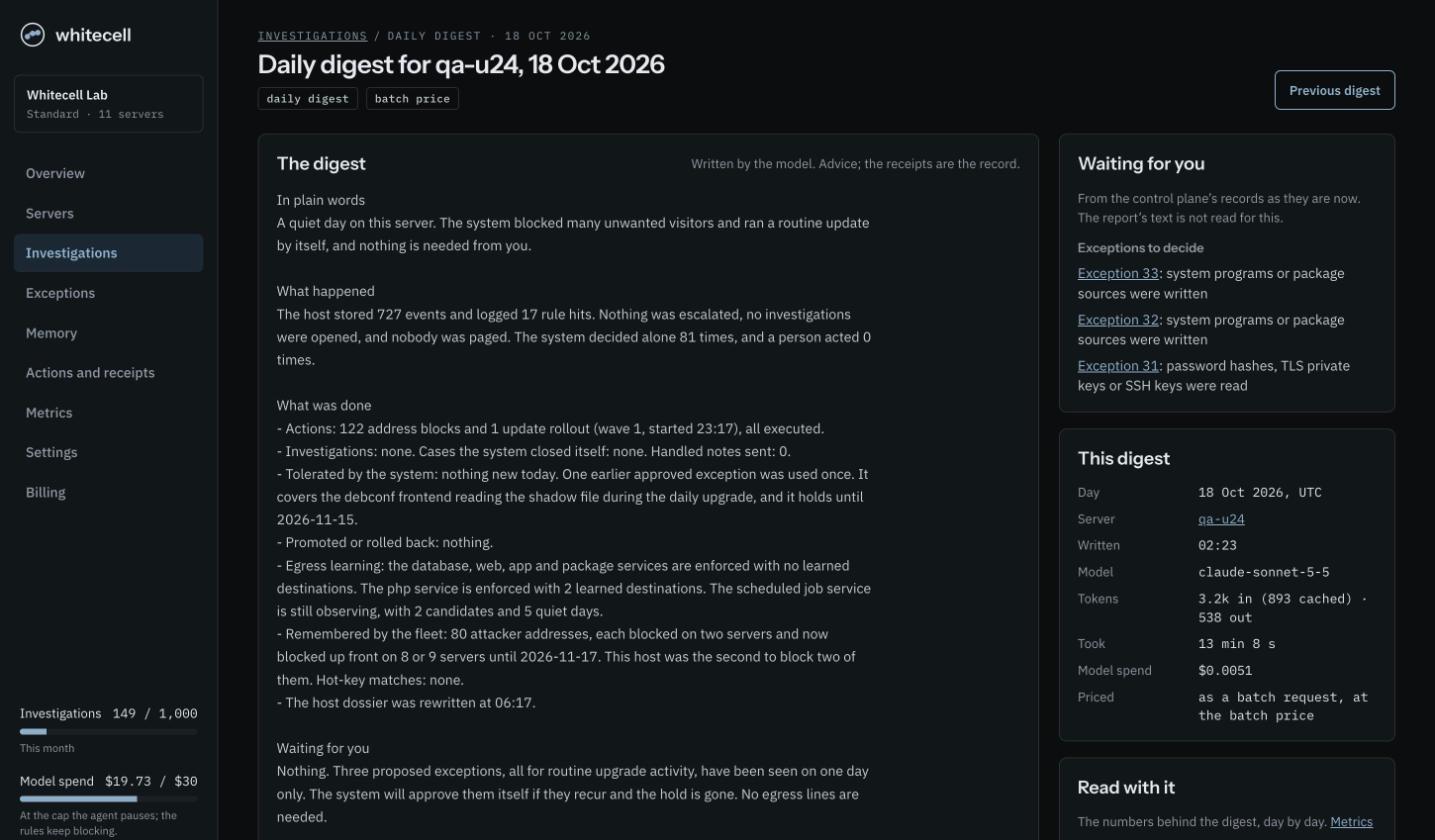
The digest is “Written by the model. Advice; the receipts are the record.” Its parts are “In plain words”, “What happened”, “What was done”, “Waiting for you”, and “Spend”. In the first week, “What was done” carries the egress learning: which services are observing, how many destinations are still candidates, and how many quiet days they have.
The “Waiting for you” card beside it is “From the control plane’s records as they are now. The report’s text is not read for this.” “This digest” gives the day, the model, the tokens, how long the batch took and the model spend. To get one sentence a day by email, turn on “A daily sentence per server” under Settings, Notifications.
What it may ask
The system asks only what no fact settles. In the first week two kinds of question are likely, and a third comes later.
- What runs that nothing explains. After the first inventory, one question: “Here is what runs on web-01 that nothing explains: 3 things. Are these yours?”, with each thing in words, such as “A program called sync-tool is installed in /usr/local/bin.” Answer “These are all mine”, or “Some are not” and mark which. Left for seven days, each thing is asked on its own.
- An exception. A pattern that keeps coming back and looks ordinary is let through with an exception. The system approves those itself, “Never on a critical rule, on a server set to observe, or for a pattern seen on one day only. Those wait for you” on the Exceptions page.
- A destination, later. While egress is observed, a destination nothing settles stays a candidate and asks nothing. Once egress is enforced and such a connection is refused, you get: “Does php-fpm on web-01 need to reach an address in the network 203.0.113.0/24 on port 443?” Answer “Yes, allow it” or “No, keep it blocked”.
Questions appear on the Overview under Needs you. Questions and autonomy covers how they look and how long they wait, and Exceptions covers the third kind.
Promotion: quiet days, a check, and a way back
Each service has two switches, and the system flips each one itself once a day when its window has been quiet.
Hardening moves from audit to enforce after 7 days in audit with no would-be denial and no unit failure. The set of places the service writes must have settled too: a new place in the last 7 days makes it wait. The server then switches the service to enforce with those places writable, restarts it and watches it. For a public web service it also fetches the home page from the server itself, before and after the restart, and wants an answer below 500 within 10 seconds, retried for 30 seconds. If the unit fails or the page breaks, the server puts the previous settings back by itself and the receipt says why.
Egress is enforced once the service has been watched for 14 days and nothing new has appeared for 7. The allowed set is every destination already allowed, and every one seen at least 10 times or on 2 days. For the next hour a refused connection rolls the enforcement back, and the service then waits 14 days before the next try. A destination it needs later is allowed after a check, or asked of you.
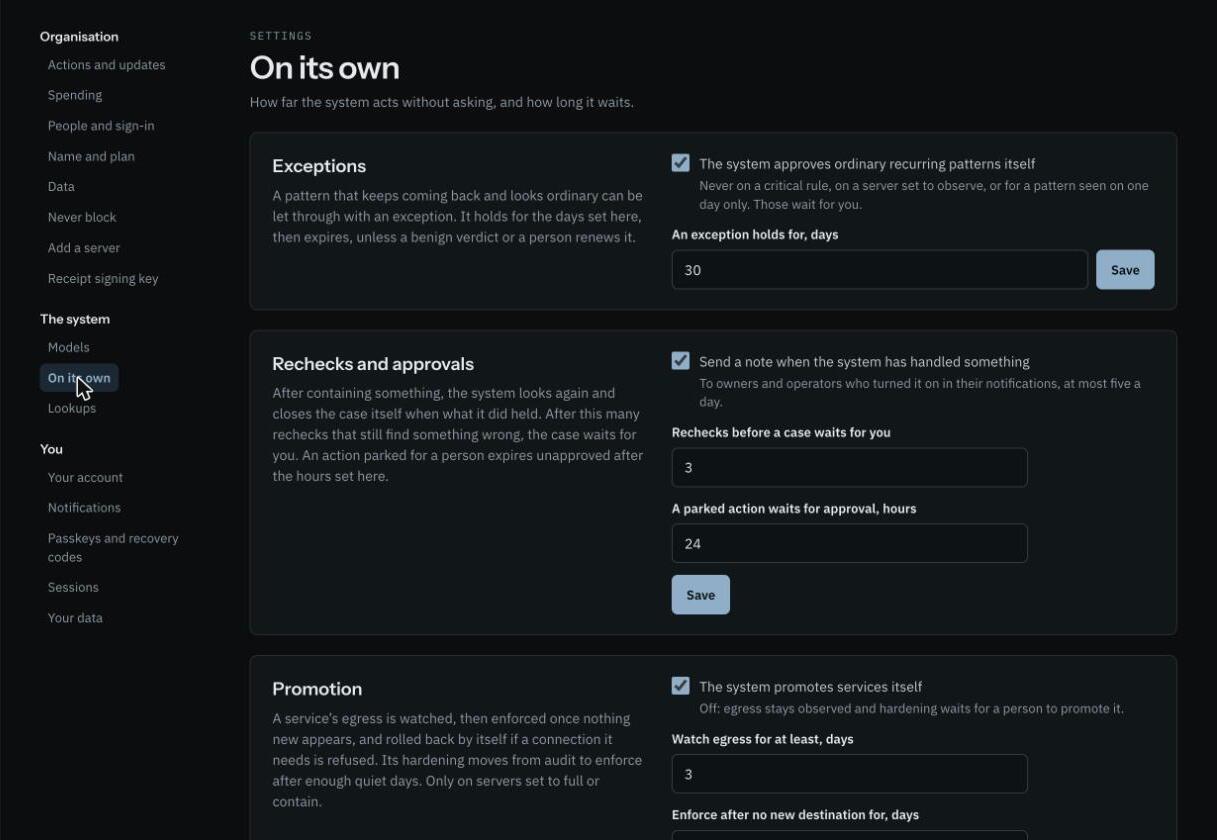
The windows are under Settings, On its own, in the “Promotion” card. It applies “Only on servers set to full or contain.”
| Setting | Default |
|---|---|
| Watch egress for at least, days | 14 |
| Enforce after no new destination for, days | 7 |
| After a rollback, wait, days | 14 |
| Quiet days in audit before enforce, days | 7 |
With “The system promotes services itself” off, “egress stays observed and hardening waits for a person to promote it”: the Services table then offers “Promote to enforce”, which the control plane accepts only after the quiet days. Demoting by hand runs on the server, with whitecell demote <service>.
The first week is free
From Pricing: “Free for every server, with no card. On day 8 without a card, the server keeps what it has and the agent stops investigating until a card is added. With a card, billing starts at the hour.”
Related
- Add a server and get the first receipt in minutes
- When it asks, and how far it acts on its own
- Tell it what is normal, once
- What it remembers, and why a destination was allowed
- The weekly brief, the daily digest and the numbers behind them
- The promotion document (promotion.md) in the repository, and the learning parts of the daemon document (daemon.md).